— stickers
—
0 filled
🖼
Upload images to fill your sticker sheet
Print 20 inkjet address labels per sheet. Same layout as 5161, made for inkjet paper. Why free?
Printing Avery 8161 inkjet address labels? This page gives you the 20-up US Letter layout with two columns, ten rows, and 1 inch by 4 inch labels already dialed in. Paste addresses, import a CSV, or repeat one label across the sheet. Avery 8161 is the inkjet version of the same layout used by Avery 5161.
Have laser labels instead? Use Avery 5161. Have 8461, 18161, or another 1" x 4" 20-up sheet? This layout should still match, but run a plain-paper test first.
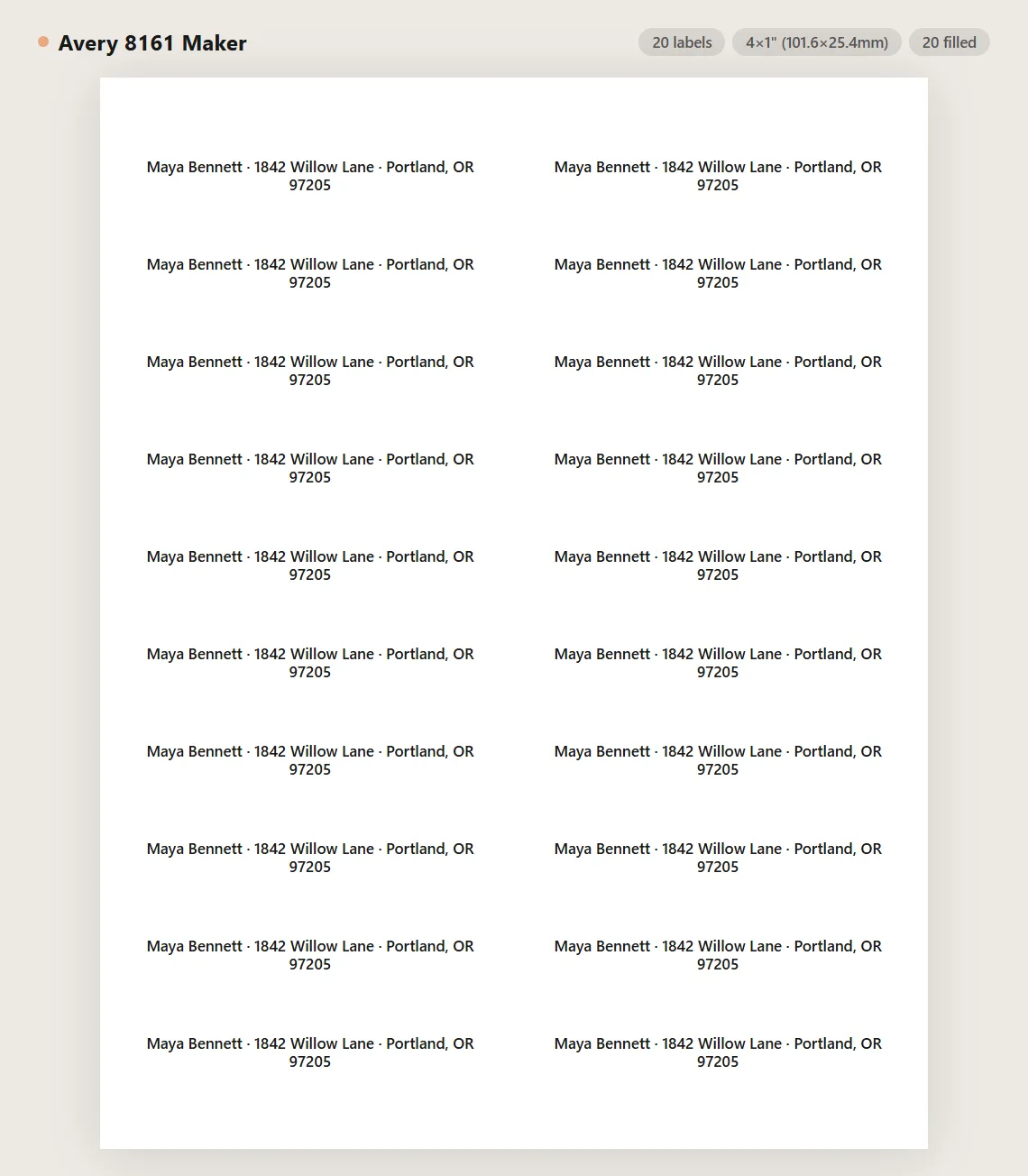
Avery 8161 is a 1" x 4" inkjet label layout with 20 labels per US Letter sheet, arranged 2 columns by 10 rows.
They share the same 20-up die-cut layout. 5161 sheets are optimized for laser printers and 8161 for inkjet printers. Templates are interchangeable.
Yes. Use Import CSV to map name, street, city, state, ZIP, and country columns. Each row becomes one multi-line label.
Yes. Type one label and use Tile / repeat, or edit one cell and choose Duplicate this cell to all cells.
Set browser print scale to 100%, disable headers and footers, and test on plain paper before loading label sheets.
Yes. Use Image+Text mode for labels with a logo, or Text mode for plain address and shipping labels.
Yes. Use per-cell editing to blank out already-used positions before printing a partial sheet.
A clear sans-serif font is easiest to read. Use bold for names or company lines and Auto-fit for longer addresses.
No. Text and CSV content stay in the browser. The page is static and does not store label data.
The first label starts 0.15625" from the left edge and 0.5" from the top. Columns repeat every 4.1875" with a 3/16" gutter, and rows repeat every 1" with no vertical gap - identical to laser-rated 5161. This page reproduces those exact coordinates instead of dividing the sheet evenly, which is what keeps the last row from drifting off its die-cut.
Most printers feed paper a fraction of a millimeter off, and on label stock that shows. Use the Printer alignment panel to print a test sheet, hold it against a label sheet in front of a light, and nudge the layout in 0.25mm steps. The setting is saved for next time.
Usually feeding, not software. Feed label sheets one at a time from the manual or bypass tray if you have one, never run a sheet through twice, and store unused sheets flat in the packaging - humidity curls label stock, and a curled sheet feeds crooked.
Business and holiday mailings with long addresses, file box and binder spine labels, shelf and bin labels, and inventory tags. Inkjet stock takes color nicely, so a colored name line or a small logo via Image+Text mode looks richer than it would from a mono laser.
Give printed sheets a minute to dry before stacking - coated label stock holds ink on the surface longer than plain paper. If your printer has a "labels" or "heavy paper" media setting, use it: the slower feed noticeably sharpens small text.
A 14 to 16 point font sits comfortably on a 1" x 4" label. Auto-fit handles it for you - it shrinks each label's text just enough to fit - but if you set a fixed size, print one plain-paper proof first and read it at arm's length.
No. This template runs entirely in the browser - nothing to install, no account, no plug-in. It replaces the Word template workflow: the 8161 grid is already measured and locked, you just add content and print. It works the same on Windows, Mac, Chromebooks, and Linux.
Yes. Use Save to store the layout in your browser and Load to bring it back, or click Share this tool to copy a link that encodes your current layout. Returning visitors are also offered a restore of their last session automatically.
Yes - no watermark, no trial, no signup. The site is supported by optional affiliate links to printing supplies, so the template tool itself stays free.
Upload images to fill your sticker sheet
Supplies
Affiliate links. As an Amazon Associate I earn from qualifying purchases, at no extra cost to you.
Not independently tested by us. Check that your sticker paper matches your printer type (inkjet or laser) and that its weight is within your printer's supported range.