— stickers
—
0 filled
🖼
Upload images to fill your sticker sheet
Print ⅔" x 3 7/16" Avery 5266 labels: 30 per sheet, no Word or signup. Why free?
The Avery 5266 template is set up for the standard file folder label sheet: two columns by fifteen rows of 2/3 x 3 7/16 inch labels, 30 per US Letter page. The long, slim shape wraps the tab of a standard file folder. Type your folder names one per line, import a CSV from a spreadsheet of files, or repeat one label across the sheet. Avery 5266 is the Easy Peel, assorted-color sibling of Avery 5366 - the die-cut grid is identical.
Avery 5266 shares this exact 30-up die-cut with Avery 5366 (white) and 8366 (inkjet); 5666 and 5966 match too. Run a plain-paper alignment test before printing on a new brand.
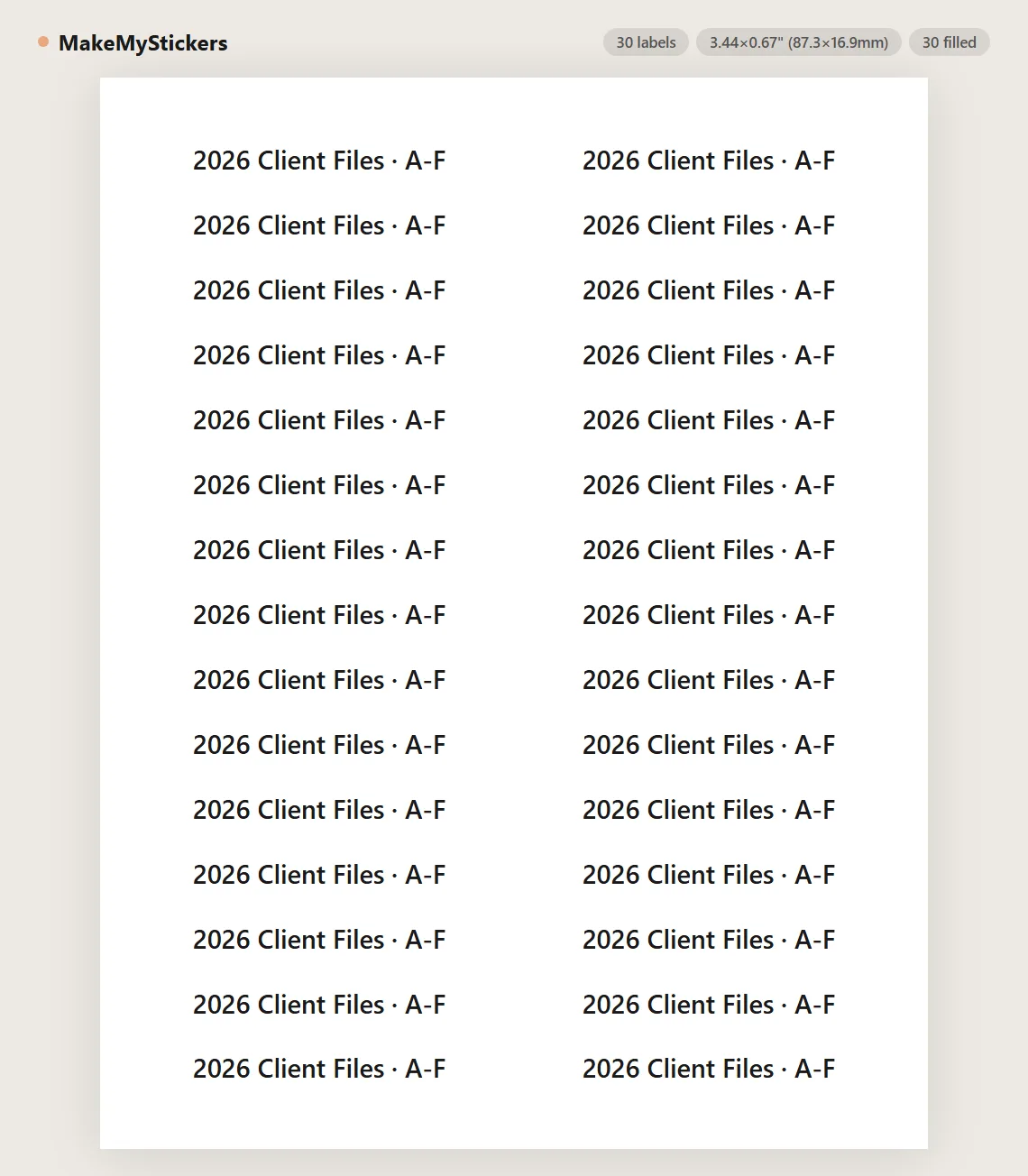
Avery 5266 is a 2/3" x 3 7/16" label layout with 30 labels per US Letter sheet, arranged 2 columns by 15 rows. It is sized to wrap the tab of a standard file folder.
File folder tabs, binder spines, drawer and shelf edges, and any place a long slim label fits. They are a staple for office and home filing systems.
Same 30-up die-cut. 5266 sheets are Easy Peel and come in assorted colors with a write-on area, which makes color-coded filing easy; 5366 is the all-white version. The template grid is identical.
Paste your folder names one per line, or import a CSV exported from a spreadsheet. Each line becomes one label, filling sheets in order.
Yes. Type one label and use Tile / repeat, or edit one cell and choose Duplicate this cell to all cells.
Set browser print scale to 100%, disable headers and footers, and test on plain paper before loading label sheets.
Yes. Avery 5366 (all white) and 8366 (inkjet) are the same 30-up die-cut. Generic file-folder label sheets usually match, but test on plain paper first.
The text color picker lets you print colored text, and you can set a background color per label for simple color-coding. 5266 sheets themselves come in assorted colors, so you can also sort categories by label color.
Yes. Use per-cell editing to blank out already-used positions before printing a partial sheet.
No. Text and CSV content stay in the browser. The page is static and does not store label data.
The die-cut starts 0.53125" from the left and 0.5" from the top; columns repeat every 4" with a 9/16" gutter, and rows repeat every 0.6667", flush - identical to 5366, so files for either print correctly on both. The proportions are deliberate: the label wraps over the top of a standard file folder tab and reads from both sides. This page reproduces those exact coordinates instead of dividing the sheet evenly, which is what keeps the last row from drifting off its die-cut.
Most printers feed paper a fraction of a millimeter off, and on label stock that shows. Use the Printer alignment panel to print a test sheet, hold it against a label sheet in front of a light, and nudge the layout in 0.25mm steps. The setting is saved for next time.
Usually feeding, not software. Feed label sheets one at a time from the manual or bypass tray if you have one, never run a sheet through twice, and store unused sheets flat in the packaging - humidity curls label stock, and a curled sheet feeds crooked.
Pick one format for every label - bold category, dash, then detail ("TAXES - 2025", "CLIENTS - M-R") - and left-align it. Consistent labels are most of what makes a filing system feel organized, and bold text reads better at an angle in a crowded drawer.
Filing labels live for years, so laser has the edge: toner will not fade or smear with handling. On inkjet (8366 stock), let labels dry before folding them over tabs, and apply to clean, dry folders - dusty tabs are why labels peel at the corners later.
Keep the folder list in a spreadsheet. Each January, re-import the CSV and the whole cabinet relabels in one print run - the importer turns the first column into labels, one per row.
No. This template runs entirely in the browser - nothing to install, no account, no plug-in. It replaces the Word template workflow: the 5266 grid is already measured and locked, you just add content and print. It works the same on Windows, Mac, Chromebooks, and Linux.
Yes. Use Save to store the layout in your browser and Load to bring it back, or click Share this tool to copy a link that encodes your current layout. Returning visitors are also offered a restore of their last session automatically.
Upload images to fill your sticker sheet
Supplies
Affiliate links. As an Amazon Associate I earn from qualifying purchases, at no extra cost to you.
Not independently tested by us. Check that your sticker paper matches your printer type (inkjet or laser) and that its weight is within your printer's supported range.